


Ths Shasta Method
The Shasta Method—a technique my team, D3!, and I still use to this day to help unbrick our hands and maintain consistent gameplay. This isn’t a strategy designed to help you win more games—it’s a strategy that helps you play more games effectively. Some of the best Union Arena players use this same method to perform at a consistently high level.
The Shasta Method written by Shasta 12/29/20025
This isn’t a strategy to win more games, this is a strategy to let you play more games
This write-up is based on opening hand scenarios where your energy curve is missing. The goal is to evaluate them and calculate your chances of “unbricking” your opening hand. “Bricking” is a common talking point between players that fuels discussions of mulligan changes, new power-creeping cards, and the viability of the competitive scene for Union Arena. Bricking is believed to be far too common among the player base. I believe the driving force behind most bricks is greed. Players will mulligan hands they shouldn't, risk getting lucky, then get frustrated when it fails. Blaming the game and RNG and offloading the accountability for their decision making. I believe this occurs more often than people want to believe. These scenarios will focus on securing your energy curve in your opening hand. I will calculate the probability of finding the card you need off the top of your deck using best and worst case scenarios of your “curve” targets being in your life. And calculate your chances of drawing it with every turn draw and AP draw.
Test parameters • Using Blue JJK deck as a sample deck • No extra draw effects (fingers, nobaras, etc) • No searchers (usually a 1c) • Draw until your curve is guaranteed
Things to think about • Know when to hold em, and when to fold em ○ No 0 drops? Should mulligan ○ Open 1 energy? Maybe mulligan, maybe not, depends ○ Open 2 energy? Not likely mulligan, but possible with exception
Goals • Use all AP in your first (3) turns ○ 6 AP if going first ○ 7 AP if going second • Start drawing ASAP, don’t hesitate. It’s more important to fix your hand, than to maintain “board presence” • If you still “hard bricked’, well, that's RNG, shit happens. At least you did everything you could, no regrets
Standard Ratio build Energy Cost 12, 0 drops 4, 1 drop 4, 2 drop
Cookie cutter ratio for this will have 20 cards that are in the 0-2 cost range. Decks will vary and it will depend on you to know what you need to reach your goals. The same principles will apply, but the chances change, and your decision to mulligan will be more intuitive to you, your build and strategy.
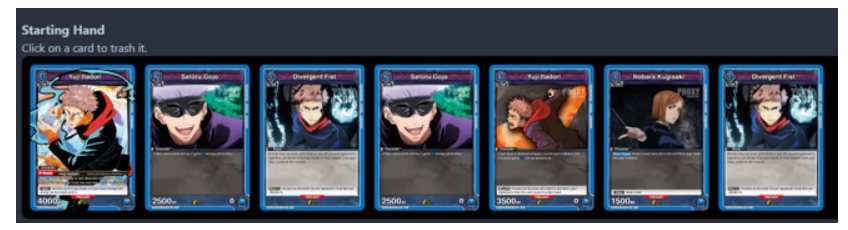
Finding the 1 curve is not ideal and players will likely opt to mulligan at first sight. But after further evaluation, a player should reconsider due to the potential strength of this hand. Also considering it is only one card away from an established, and strong, energy curve. Here are my reasons why:
• You opened with half of your 2 costs (which are strong energy stabilizers), your next hand is likely (74%), to have 2 energy without a 2 cost. Although you may find your curve to 3 energy, it is not as stabilized as it could have been with your 2 costs and they can be potential non triggers. • If you mulligan into another 1 energy hand (31%), there's only a 5.4% chance to have it open with another 2 cost.Given these circumstances, you might choose to keep this hand. So its actually ~26% to have a similar hand. The 31% is likely worse than it objectively seems.
However, if you decide to mulligan, ChatGPT says • You have a 74% chance to open with 2 energy on your next 7 cards. • But it's also a 31% chance you mulligan into another 1 energy hand.
The numbers are still in your favor, but the potential to be unlucky will hit harder. When the hand really isn’t as bad as most players think. Should you take the chance?
So lets say you do keep this hand, or you were forced to mulligan and ended up with this hand, lets look at the numbers on the next page.
Here’s the breakdown
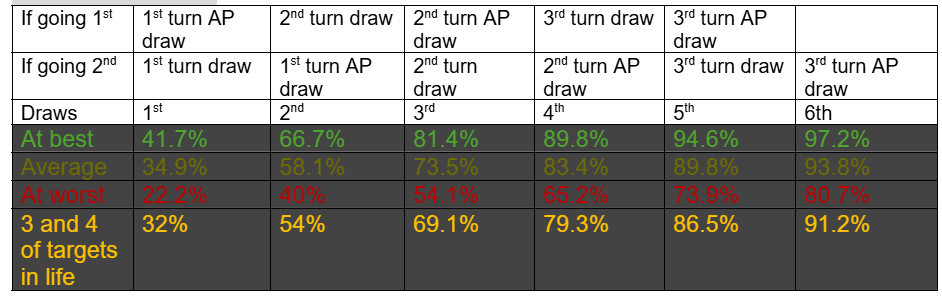
Best case scenario is none of your targets are in your life, 15 targets in 36 cards.
Worst case scenario is your life is filled with targets, (15 – 7) targets in 36 cards.
And average is randomized life
And the last row is the middle of the road probability where average of 3 and 4 targets in life are averaged. This is considered the most realistic expectation.
Example Results
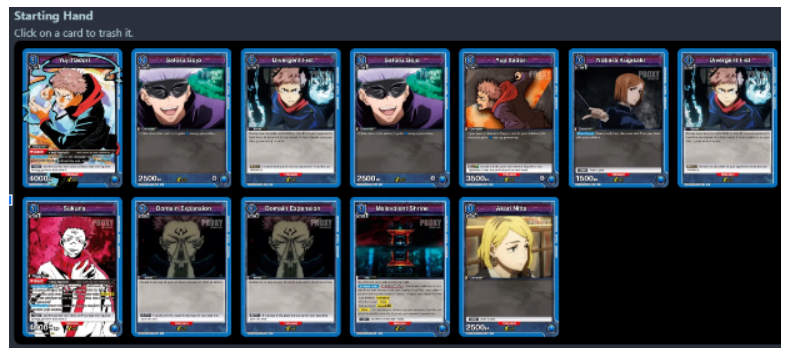
Here, I found my curve on the 5th draw. Thats 3 AP draws and 2 turn draws going into my 3rd turn. Assuming just straight draw and no extra draw effects. If we used Nobara’s effect, we wouldn't have needed the 3rd AP draw and would have drawn the card we needed going into our 3rd turn. If by then we still haven't found our energy curve, the Nobara still allowed us to dig deeper if necessary. The key point here is that you should not play Nobara on your first turn, and rely on her as if it's an extra draw. Because if you didn't draw an energy card, and it is 1 more card away, on your 2nd turn, action points will go unused as you attempt to AP draw out of your brick. BIG OOF!! Because of reliance on luck, you risk action points that go unused over your opening turns. Secure your curve! AP draw on your first turn! Don’t be greedy!
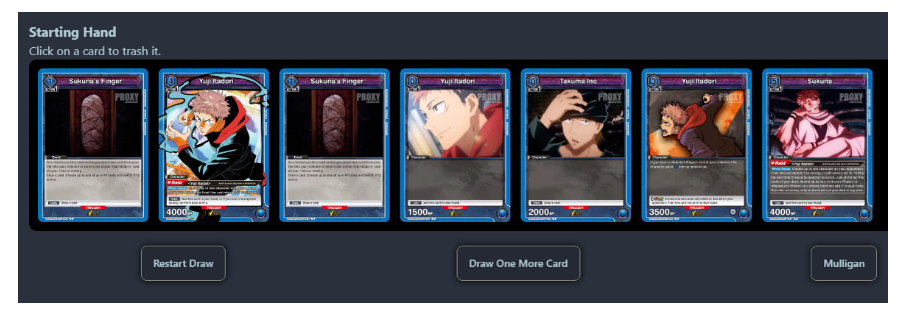
The 2 curve is the more favorable to fix. As per parameters, no extra draw effects or searches, so we assume the fingers are just other 3c or higher cards. I want to believe people wouldn't mulligan this hand, but maybe they still do with hands similar to this, and end up in a worse situation.
Here is the breakdown for finding your curve
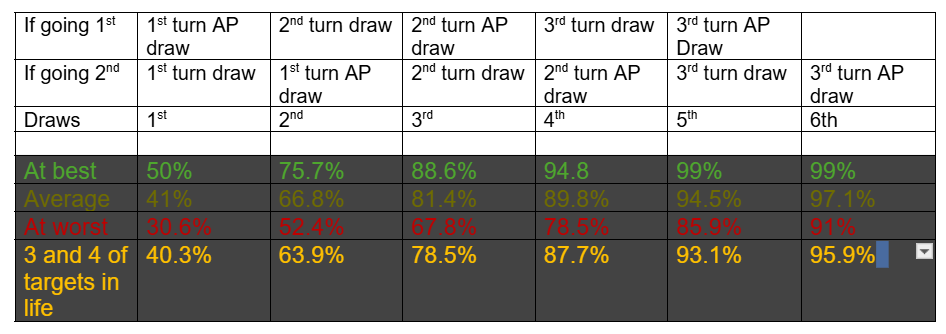
Best case scenario is none of your targets are in your life, 15 targets in 36 cards. Worst case scenario is your life is filled with targets, (15 – 7) targets in 36 cards. And average is randomized life And the last row is the middle of the road probability where average of 3 and 4 targets in life are averaged. This is considered the most realistic expectation.
Example Results
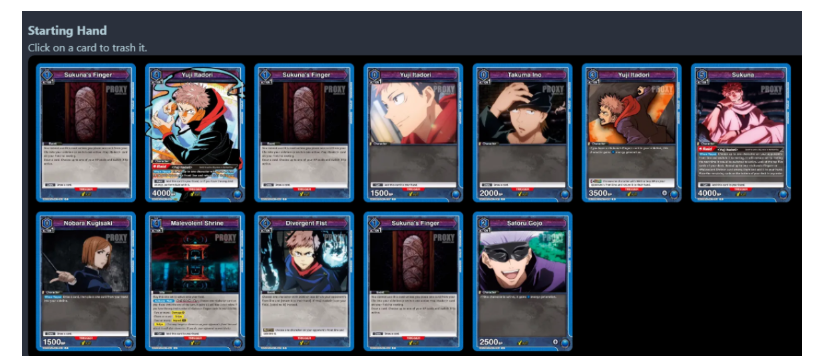
Assuming the 0c Nobara was something else 3c or higher, we dug 5 cards deep and we found our curve on pure top decking. In an RL scenario, you AP draw the Nobara, and play out your curve since the Gojo wasn’t necessary for it, but now you have options. If you did not AP draw on your first turn, and that Nobara was something else, you potentially let 3 action points go unused over your next 2 turns. DON’T DO THAT! AP DRAW!
This whole thing is to address hands that look unplayable to players but are actually very playable given the correct decisions. The first 3 turns are the most important in this game. So let me pose a hypothetical,
Would you rather take a few life hits when you are able to play the game? Or inadvertently lose the game because you wanted “board presence”?
Life is a resource, and in a non-optimal situation, you might need to use more of it than you would like. Yes, it will put you a little behind, but what better option do you have? The game isn’t always decided by the opening turns. Actually, many players will say the game is decided by the RNG of life triggers. And sometimes players will have objectively good triggers but weren't able to utilize them optimally. A lot of things can happen in the mid game. Maybe when you start establishing your board your opponent has weak triggers and weak counter plays? Maybe your opponent soft bricks in the mid game with no raids or raid targets? Who knows? You must play the game to find out, so don't throw the game in your first. turns
This isn’t a strategy to win more games, this is a strategy to let you play more games. No free wins for your opponents. Just because you didn’t high roll, doesn’t mean you can’t edge them out with good decision making. Check your greed, and don’t rely on hard luck to bail you out. Create your own, by giving yourself more chances, and more options. Then listen to your opponent claim you were just luckier, knowing that you fought your way out.
These examples do not consider extra draw effects or searcher cards. Or “get” or “draw” triggers that can help you. If you have these cards, and most decks do, your likelihood of staying “bricked” is actually rare. Yet, many players complain of this exact issue. I don’t fully understand it, but I know a mulligan change won’t correct the issue. I used to believe in mulligan changes, but not anymore, not for a while, and likely never. Any new support will help the issue, but I suspect there will always be complaints of bricking. RNG exists, it happens, but not as often as many of these players want to believe. Depending on the deck and build, you may be able to get away with a non-standard ratio build, or riskier hands. That’s up to you to figure it out. The greed begins in the cards you select. When you build a greedy deck, then keep a greedy hand, and make greedy decisions, don’t be surprised when you are in a deep greedy hole. Union Arena is a best of 1 game, so if you play like that, you should just sit down, flip a coin, and mark your loss 50% of the time. Otherwise, if you haven’t drawn your curve yet, keep going. Don’t stop until you have guaranteed it. NO FREE WINS FOR YOUR OPPONENTS!
ChatGPT prompt https://chatgpt.com/c/68c9fe65-e3a0-8332-b465-b71d3b3ab871
Feel free to check math, AI can/does make mistakes
Mulligan percentages 1 energy = (1) 0 cost 2 energy = (2) 0 costs OR (1) 0 cost and (1) 1 cost
71% to open with 2 energy in your opening 7 92% to open with 2 energy from 0 energy mulligan 74.5% to open with 2energy from 1 energy mulligan 68.7% to open 2 energy from 2 energy mulligan 31% to open 1 energy from 1 energy mulligan 1% to open 0 energy from 0 energy mulligan