

Open IP Format Rules
Join us on our journey into a fun alternative format for Union Arena! Rules, Explanations, and ban/restriction list all in one place.
Updated Jun 25, 2026

Open IP Format Rules, Restrictions, and Watch List
Open IP is a custom Union Arena format built to let players explore combinations that are not normally possible in standard play. The goal of the format is simple: keep the core structure of Union Arena intact while removing the restriction that locks a deck into one IP.
This creates a format where players can experiment with new engines, support pieces, and win conditions across different titles while still respecting the normal color identity and deckbuilding rules of Union Arena.
What Is Open IP?
Open IP is a Union Arena format where players may build decks using cards from multiple IPs instead of being restricted to a single series.
For example, under normal Union Arena rules, a deck is built using cards from one IP. In Open IP, players can combine cards from different IPs as long as the deck still follows the standard color rules and normal deck construction requirements.
The purpose of the format is not to replace standard Union Arena. It is meant to be an additional way to play the game, giving players more room to brew, test strange combinations, and find new strategies that would never exist in normal constructed play.
Basic Deckbuilding Rules
Open IP follows normal Union Arena deck construction rules unless stated otherwise.
A legal Open IP deck must follow these rules:
Decks must contain exactly 50 cards.
Decks must follow normal color restrictions.
Players may use cards from any number of IPs.
The deck must include at least 12 cards from IPs outside the deck’s primary IP.
Finals do not count toward the 12-card outside-IP requirement.
Trigger rules, color rules, and normal gameplay rules still apply.
In short, Open IP uses Union Arena’s normal rules as the foundation, but allows players to mix IPs while requiring a meaningful amount of outside-IP inclusion.
Primary IP
For clarity, a deck’s primary IP is the IP that makes up the largest portion of the deck.
The 12-card outside-IP requirement exists to make sure Open IP decks are actually using the format’s identity rather than simply splashing one or two powerful cards into an otherwise normal constructed deck.
The goal is to encourage real deckbuilding choices, not just minor upgrades to existing standard lists.
Why Finals Are Excluded
Finals are excluded from the 12-card outside-IP requirement because they are often tied more to color and deck structure than to the actual identity of the strategy.
Since every deck already needs Finals, counting them toward the outside-IP requirement would make the rule too easy to satisfy without meaningfully changing how the deck plays.
Open IP is meant to reward creative cross-IP deckbuilding, so the requirement focuses on the main deck cards that actually shape the strategy.
Standard North American Ban and Restriction List
Open IP will now follow the official Union Arena North American ban and restriction list in addition to any restrictions created specifically for Open IP.
Any card that is banned, restricted, or limited under the current North American constructed rules will have the same legal status in Open IP. When the official North American list is updated, those changes will also apply to Open IP unless an Open IP announcement specifically states otherwise.
This change is being made to keep the format easier to understand and manage. Players should not have to learn two completely separate sets of rules for cards that have already received official balance action.
The official North American list also gives Open IP a stronger starting point. Cards and interactions that have already been judged unhealthy in standard constructed play should not automatically become legal again when players gain access to a much larger card pool.
Open IP will still maintain its own additional restriction list and watch list.
The official North American list addresses cards based on their performance in standard constructed play. Open IP restrictions address problems created or amplified by cross-IP deckbuilding. A card may remain fully legal in standard play while still receiving an Open IP restriction if access to cards from other titles causes the interaction to become unhealthy.
Players are responsible for checking both the current North American ban and restriction list and the additional Open IP rules before submitting a deck.
Current Restricted List
The following restriction is currently active:
If your deck contains Saitama UE06BT/OPM-1-061  You may only play 1 copy of We Fight Now!! We Decide This Right Here!! UE10BT/AOT-1-064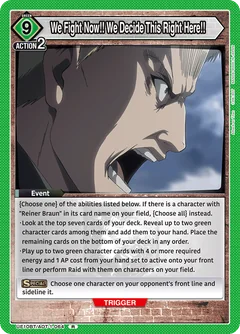
This means that the card is not globally restricted. The restriction only applies when Saitama UE06BT/OPM-1-061 is present in the deck.
Restriction Explanation
Saitama UE06BT/OPM-1-061 creates a unique problem in Open IP because the format gives him access to tools he was not originally designed around. In standard play, his support options are limited by the One Punch Man card pool. In Open IP, he can be paired with cards from other IPs that dramatically improve his ability to close games.
We Fight Now!! We Decide This Right Here!! UE10BT/AOT-1-064 is especially concerning with Saitama because it can push the deck’s explosive turns too far. The interaction creates too much burst potential while also making the deck harder to properly interact with.
The goal of this restriction is not to remove Saitama as a playable strategy. The goal is to keep Saitama decks from gaining access to too much consistency and finishing power from an outside-IP card that was not balanced with him in mind.
By limiting this specific card to 1 copy only in Saitama decks, the deck can still exist, still have access to the effect, and still produce powerful turns, but it is less likely to repeatedly create the same overwhelming endgame.
Current Watch List
The following cards and card pairings are currently on the Open IP watch list:
Hakuri Sazanami and Kenshin Himura
Hakuri Sazanami UE16BT/KGR-1-047 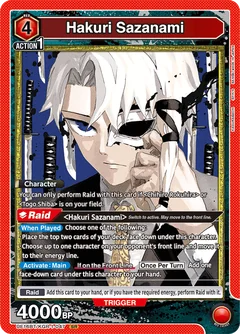
Kenshin Himura UE11ST/RNK-1-106 
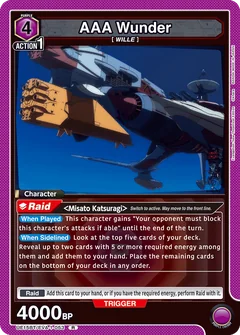
Evangelion Test Type-01 (Spear of Gaius) and AAA Wunder
Evangelion Test Type-01 (Spear of Gaius) UE15BT/EVA-1-033 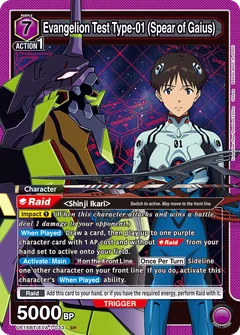
Saitama
Misato Katsuragi
Misato Katsuragi UE15BT/EVA-1-008 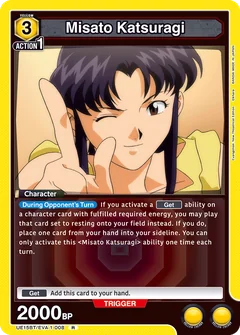
All of these cards are currently legal.
They are not currently banned.
They are not currently restricted beyond any restrictions that may already apply through the official North American ban and restriction list.
They are being watched for potential future action in Open IP.
Watch List Explanations
Hakuri Sazanami and Kenshin Himura
Hakuri Sazanami UE16BT/KGR-1-047 and Kenshin Himura UE11ST/RNK-1-106 are being monitored because of the potential for the two cards to create play patterns that are too efficient or too difficult to answer.
Kenshin is already a strong card on his own, and Open IP gives him access to support outside of his original card pool. Hakuri may improve the consistency of those lines or allow Kenshin to be used in ways that push the interaction beyond what is healthy for the format.
The pairing has not received any action because the format still needs more tournament results and match data. If it becomes too repetitive, too reliable, or too central to successful deckbuilding, a future restriction may be considered.
Evangelion Test Type-01 (Spear of Gaius) and AAA Wunder
Evangelion Test Type-01 (Spear of Gaius) UE15BT/EVA-1-033 and AAA Wunder UE15BT/EVA-1-053 are being watched because of how much they add to an already powerful late-game strategy.
The deck already has access to a strong and difficult-to-avoid endgame thanks to other power houses from different IP's. The addition of early removal gives it more control over the turns leading into that endgame and makes it harder for opposing decks to establish pressure before the deck reaches its strongest stage.
AAA Wunder also discourages opponents from attacking, which can slow down the game while giving the Evangelion player additional time to assemble its late-game position.
The concern is the complete package. A deck with one of the strongest inevitable late games may also have access to efficient early interaction and effects that make normal aggression less appealing.
This pairing remains legal while more results are collected. Future action may be considered if the deck proves too effective at controlling the early game while also maintaining an endgame that other strategies cannot reasonably match.
Saitama and Misato Katsuragi
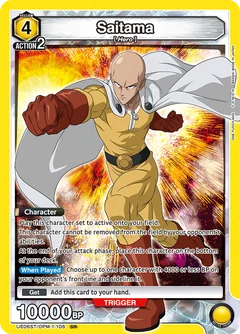
Saitama UE06ST/OPM-1-106
Misato Katsuragi UE15BT/EVA-1-008
Saitama UE06ST/OPM-1-106 and Misato Katsuragi UE15BT/EVA-1-008 are being watched together because of the consistency they give to an already powerful set of life triggers.
Misato Katsuragi UE15BT/EVA-1-008 already has a strong effect on her own. When paired with Saitama UE06ST/OPM-1-106, she can play a character out of the life area that removes any character on the opponent’s board when triggered. That same character can also block any opposing character, giving the deck access to both removal and defense from a single life trigger.
This interaction effectively gives the deck access to eight Special-like triggers from life. Four copies of its normal Special trigger can be played alongside four copies of Saitama out of life thanks to Misato.
The concern is the overall quality of the deck’s life area. Opponents may be punished for attacking by either a normal Special trigger or a Saitama trigger that removes a character and provides a flexible blocker. This can make attacking into the deck unusually dangerous while giving the Evangelion player access to a level of life-trigger consistency that other decks may struggle to match.
Both cards are currently legal, and no restriction is being applied at this time. The pairing will be monitored through tournament results and continued testing to determine whether access to eight high-impact removal triggers from life gives the deck too much consistency, defense, and control.
Philosophy Behind Bans and Restrictions
The goal of the Open IP ban and restriction list is not to remove strong decks from the format. Strong decks should exist. Powerful combinations are part of what makes Open IP fun.
The goal is to prevent combinations that damage the format by being too consistent, too explosive, or too difficult to interact with.
A card or pairing may be considered for restriction if it does one or more of the following:
It creates a win condition that happens too reliably with limited counterplay.
It makes one deck clearly stronger than the rest of the format.
It removes meaningful decision-making from games.
It causes too many decks to be built around beating one specific strategy.
It uses cross-IP interactions in a way that breaks the intended pacing of Union Arena.
Restrictions are preferred over bans whenever possible. If a card can remain playable in a healthier form, limiting copies is usually better than removing it completely.
Bans should be reserved for cards or combinations that cannot be solved through lighter restrictions.
Why Open IP Needs Its Own Balance List
Open IP gives cards access to support they were never originally designed to have. That is the entire appeal of the format, but it also means some combinations will be stronger than expected.
A card that is fair inside its own IP may become much stronger when paired with the best search, draw, removal, restand, or finishing tools from other IPs.
Because of that, Open IP needs its own balance list separate from normal Union Arena constructed play.
This does not mean a card is a problem in standard. A restriction in Open IP only reflects how that card behaves when the IP restriction is removed.
Format Goals
The main goals of Open IP are:
To create a fun and creative way to play Union Arena.
To let players build decks across multiple IPs.
To encourage experimentation and discovery.
To keep games interactive and skill-based.
To avoid one deck or combo becoming the entire format.
To preserve the basic feel and pacing of Union Arena.
Open IP should feel powerful, creative, and different, but it should still feel like Union Arena.
Current Legal Status Summary
Saitama UE06BT/OPM-1-061 is legal.
We Fight Now!! We Decide This Right Here!! UE10BT/AOT-1-064 is legal.
If both are in the same deck, We Fight Now!! We Decide This Right Here!! UE10BT/AOT-1-064 is limited to 1 copy.
Hakuri Sazanami UE16BT/KGR-1-047 is legal.
Kenshin Himura UE11ST/RNK-1-106 is legal.
Hakuri Sazanami UE16BT/KGR-1-047 plus Kenshin Himura UE11ST/RNK-1-106 is currently legal, but on the watch list.
Open IP follows the current official Union Arena North American ban and restriction list.
Any card restricted or banned under the official North American rules has the same legal status in Open IP.
Evangelion Test Type-01 (Spear of Gaius) UE15BT/EVA-1-033 is legal and currently on the watch list with AAA Wunder UE15BT/EVA-1-053.
AAA Wunder UE15BT/EVA-1-053 is legal and currently on the watch list with Evangelion Test Type-01 (Spear of Gaius) UE15BT/EVA-1-033.
Saitama UE06ST/OPM-1-106 is legal and currently on the watch list.
Misato Katsuragi UE15BT/EVA-1-008 is legal and currently on the watch list.
Final Notes
Open IP is still developing, and the format will continue to evolve as players test more decks and find new combinations. The current restriction list is intentionally small because the format should have room to breathe before too many changes are made.
Players are encouraged to experiment, share lists, report problem interactions, and help shape the format through actual games rather than theory alone.
The goal is to build a format that feels exciting, creative, and competitive without becoming unhealthy or repetitive.